
Siamese Mah Jongg®: Official Rules and FAQ

What is Siamese Mah Jongg®?
Siamese Mah Jongg® is a two-player mahjong game created by Gladys Grad. The game is trademarked and follows the official Siamese Mah Jongg® rulebook.

How do you play Siamese Mah Jongg®?
According to Gladys Grad’s official rules, two-player Siamese Mah Jongg® is played as follows:
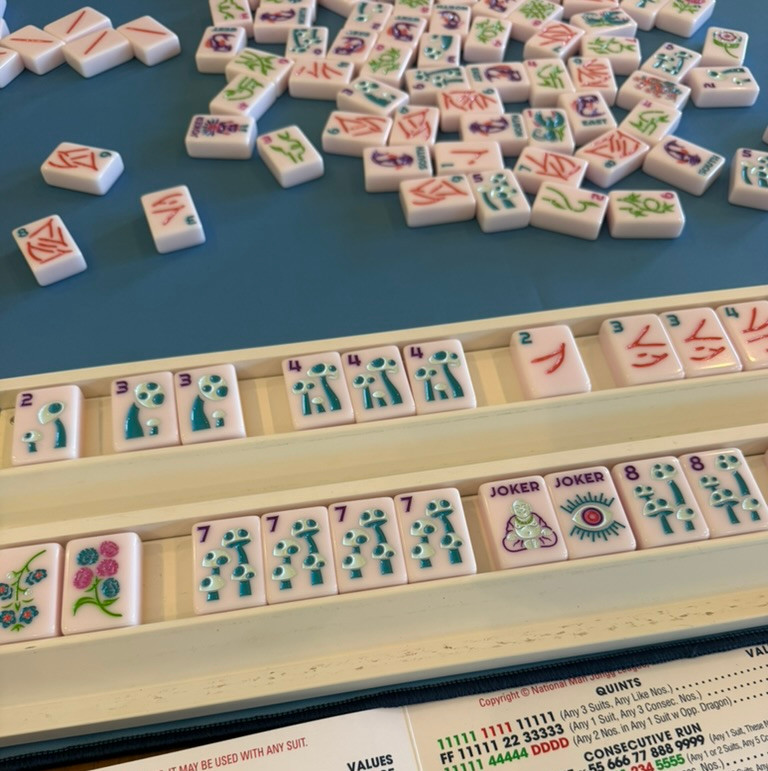
1. Two players, using two racks each (Or two players using one Double Siamese Rack each.) Two players face each other, and two racks are placed in front of each player.
2. Walls
Option A (two individual racks): Build two full walls of tiles, 19 stacks long and 2 tiles high (38 tiles total), placed in front of each rack. Once the first wall (closest to the middle) has been pushed out, move that rack behind your other rack. This allows your second wall to be pushed out when needed.
Option B (Double Siamese Rack): Build two walls, one behind the other, with a Pusher placed between each wall. The walls can then easily glide out using the Pusher.
3. No walls We do not support playing without building walls. It is an option for social play only. Simply leave the shuffled, unpicked tiles on one side of the table, and discard on the other side. Players should also occasionally move the tiles in that “messy pool” (reshuffling) to prevent any somewhat nefarious “planting” of tiles.
GG’s note: Walls help prevent players from “accidentally remembering” where some Jokers might be located. GG’s note: Walls are required for tournament play.
4. East throws a single die to break (cut) the wall Breaking the wall works like cutting a deck of cards.
A. East throws one die to break their first wall and counts from the right side of the wall the number of tiles shown on the die. The player then moves the counted stacks to the tail end of the first wall.
B. Both of East’s walls come out before the opponent’s walls are used, moving clockwise.
5. 27 tiles for East, 27 tiles for the opposite player Each player deals themselves four tiles at a time from East’s cut wall (2 stacks of 2 tiles = 4 tiles) until both players have 27 tiles each.
GG’s note: Statistics have shown that East, when given an additional tile during the deal, has a distinct statistical advantage over their opponent(s) to build or change their hands. Our goal is to remove any benefit that “luck” might have in our games, and this change serves to eliminate or reduce any statistical advantage, no matter how small.
6. Arranging your tiles Players may arrange their tiles across both racks as desired and may exchange tiles back and forth between their own racks. It does not matter how many tiles are on (or still not exposed on) the slanted level of each rack at any one time, even if or when an individual hand has been declared “dead” or “out.”
7. Charleston There is no Charleston.
GG’s note: You have access to 50% of the tiles and a multitude of tile combinations over which you have control.
8. The game begins East picks their 28th tile from the wall to begin the game, then discards. The opponent then picks a tile from the wall or claims the discarded tile, and the game proceeds. (See Rule 5 above.)
9. Jokers You may exchange Jokers from your own exposures or from your opponent’s exposures, but you may not exchange a Joker from any exposed Mah Jongg hand. Jokers may be exchanged from exposures in a “dead” hand only if that exposure did not cause the hand to be declared “dead” or “out.”
10. Mah Jongg Once a player declares and exposes Mah Jongg with the required 14 tiles and discards a tile to complete their turn, that player may keep any remaining tiles on one or both of the slanted portions of their rack(s).
These rules are published on MissyMahjong.com with the approval of Gladys Grad. For in-depth strategy, rules and other variations of Siamese Mah Jongg®, visit her official site.
Is Siamese Mah Jongg® just any version of two-player American mahjong?
No. Gladys Grad created a specific set of rules and a specific game called Siamese Mah Jongg®. For a simple way to play two-player mahjong, try my version of one-on-one mahjong, inspired by Gladys’s official Siamese Mah Jongg®.
Why does it matter if I call my game Siamese Mah Jongg®?
Calling your own version of two-player American mahjong “Siamese Mah Jongg®” is unethical. Give credit where credit is due. In an industry full of copycats and fraudulent tiles and cards, do the right thing and honor the creator. Gladys Grad has protected her name and her version of American mahjong with a registered trademark.
The misconception that any and every two player game is called "Siamese" is wrong. Even if you see the name printed in rule books from top mahjong companies like Oh My Mahjong, Siamese Mah Jongg® beware that these may not be the official rules that are on this page, on Gladys' page or in the official Siamese Mah Jongg® rulebook.
Videos put out by American mahjong teachers often claim to teach Siamese Mah Jongg®. Table rules can exist for the game, but the official Siamese Mah Jongg® rules are printed on this page. Beware of any video tutorials or paid classes from American mahjong teachers offering the wrong rules as a standard.

Do I have to play Siamese Mah Jongg® by the official rules?
You can play your game any way you want! If you call it Siamese Mah Jongg®, though, please credit Gladys Grad for inspiring your version of two-player American mahjong. I recommend purchasing the official Siamese Mah Jongg® rulebook and the annual cards. Buy them here.
This article was reviewed and approved by Gladys Grad, owner of Siamese Mah Jongg®, in October 2026.


